• For generations, teaching has been a profession pulled in two directions: the deeply human work of shaping minds and the administrative burden of systems. Lesson planning, marking, attendance tracking, and endless preparation of slides have often crowded out the very thing that draws people to teaching in the first place, working with students as individuals. I’ve known many good teachers pushed to different careers because of the non-teaching functions.

    As artificial intelligence becomes embedded in education, there is a growing fear that teachers will be replaced or reduced to mere supervisors of machines, the owner of the fingers that press Ctrl-Alt-Del. But this view misses a more hopeful, and arguably more probable, outcome. Rather than diminishing teachers, AI has the potential to liberate them from mundane tasks and elevate the most human aspects of the profession.

    Imagine a classroom where attendance is logged automatically, assessments are generated and marked instantly, and personalized practice materials are created in real time. These are not distant possibilities; they are already emerging. What this means in practice is that teachers can and will spend less time on repetitive administrative work and more time where they matter most: in conversation, guidance, and mentorship. Tying shoelaces, sparking hope and imagination, listening and encouraging.

    In such an environment, the role of the teacher begins to shift. No longer just a deliverer of content, the teacher becomes an interpreter, a coach, and a guide. When information is abundant and instantly accessible, the key question is no longer “Can students find the answer?” but “Do they understand it? Can they question it? Can they apply it wisely?”

    This is where higher-order human skills come to the fore. Empathy, psychological insight, and the ability to motivate and connect with students become more of the teaching role. A teacher who can sense when a student is disengaged, anxious, or quietly struggling provides something no algorithm can. Helping students build confidence, resilience, and intellectual curiosity requires human interaction.

    Freed from the pressure to constantly produce and grade work, teachers can invest more time and effort in dialogue, asking probing questions, exploring discussions, and engaging in one-to-one support. They can spend time understanding how each of their students thinks, not just what they produce. This deeper engagement has the potential to improve outcomes in ways that standardised metrics alone cannot capture.

    There is also an important shift in how success is defined. In an AI-supported classroom, progress is continuously monitored, but the teacher’s role is to contextualize data and behaviour. Numbers can indicate patterns, but they cannot explain them or a student’s resulting behaviour. A student’s sudden drop in performance might reflect confusion, but it might just as easily reflect something happening outside the classroom. Interpreting these signals, and responding appropriately, requires judgment, experience, and care.

    Perhaps most importantly, this evolution restores a sense of purpose to teaching. When freed from mechanical tasks, teachers can focus on what is meaningful: helping students grow not just academically, but personally. They become architects of learning environments where students feel seen, supported, and challenged.

    Of course, this future is not guaranteed. It depends on how educational systems choose to implement technology. If AI is used merely to cut costs or increase efficiency without reinvesting in human relationships, the opportunity will be lost. But if it is used thoughtfully to remove friction and amplify human connection, the result could be a profession that is both more effective and more fulfilling.

    In that sense, the rise of AI in education does not signal the end of teaching as a human-centred profession. It may, in fact, be its renewal.


  • There’s a photograph that has become almost a cliché of our age: a polar bear, gaunt and bewildered, perched on a shrinking ice floe. It is heartbreaking, immediate, and visceral. You don’t need to understand radiative forcing or carbon parts-per-million to feel its weight. You just need to be human.

    Now try this instead: explain to a general audience that a total fertility rate below 2.1 children per woman, sustained over several decades, produces an inverted population pyramid that structurally undermines pay-as-you-go pension systems, compresses the tax base, and generates compounding fiscal pressure on healthcare expenditure. Accurate. Important. And roughly as emotionally arresting as a depreciation schedule.

    This, in a sentence, is why demographic collapse is arguably the most significant economic crisis of the 21st century that almost nobody is treating as a crisis.

    The numbers are not subtle

    The OECD average total fertility rate has fallen from 2.84 children per woman in 1970 to 1.40 in 2024. South Korea — one of the world’s most technologically sophisticated economies — recorded a rate of 0.75 last year. Italy has coined the phrase “demographic winter.” Japan has been living the consequences for thirty years: a shrinking domestic market, a care burden overwhelming the state, and a stagnation so entrenched it has its own economic literature.

    The mathematics here is not complicated, and that’s rather the point. If each generation is roughly half the size of the one before it, the implications for economic growth, public finances, and social structure are not speculative — they are arithmetically inevitable. The people who will be of working age in 2045 are already born. There is no policy lever that changes this quickly. A fertility rate cannot be reversed in a generation; the lag time is a generation.

    And yet this story receives a fraction of the policy attention, media coverage, and institutional energy devoted to climate change. Why?

    Images beat equations every time

    Part of the answer lies in something we as educators see daily: most people, including highly intelligent and educated people, do not engage intuitively with numerical reasoning. They engage with stories, images, and emotion. Climate change has all three. Rising sea levels threaten recognisable coastlines. Storms are immediate and televisual. The polar bear is a protagonist.

    Demographic decline has none of this. Its consequences are slow, cumulative, and statistical. Nobody photographs a pension fund’s worsening dependency ratio. The “victims” of demographic collapse are, paradoxically, the elderly — a group that inspires concern rather than urgency — and the unborn, who by definition cannot advocate for themselves. The crisis unfolds in spreadsheets and actuarial tables, not in storm footage.

    There is also a political dimension. Climate change, for all its complexity, offers a morally legible narrative: there are villains (polluters), victims (the vulnerable), and heroes (activists and green-tech pioneers). Demographic decline has no villain. Choosing not to have children, or having fewer of them, is a deeply personal and entirely legitimate decision. Politicians are understandably reluctant to tell citizens they are collectively making the wrong reproductive choices.

    Why IB teachers should care

    This matters for us specifically because IB Diploma students are exactly the cohort who should be able to engage with numerical arguments that the general public finds inaccessible. Economics, Mathematics, Global Politics, Environmental Systems & Societies, and Theory of Knowledge all touch on this territory, but rarely connect the threads explicitly.

    The interaction between these two crises is itself worth teaching. Climate stress in developing regions accelerates emigration to wealthier ones — the very migration that wealthy countries currently rely on to paper over their fertility deficits. Meanwhile, fiscal pressure from aging populations may crowd out the public investment needed to fund a green transition. These are not separate problems.

    What our students need — and what most public discourse fails to model — is the capacity to hold a quantitative argument in mind without needing it dramatised first. The demographic data is available, the projections are robust, and the arithmetic is, frankly, straightforward. If we are serious about educating students to engage with the world’s real complexity, this story deserves a place in the curriculum alongside the polar bear.

    The ice floe is melting. But the maternity ward is also getting quieter. Both facts matter.


  • The global conversation around children, teenagers and social media is reaching fever pitch. From Australia’s ban for under-16s to the shifting legislative landscape in Europe, the message from governments is clear: ‘We must protect the children.’ While the motive, safeguarding young people’s mental health, is undeniably noble, as educators committed to the IB’s focus on critical thinking and global contexts, we must ask: Is a blanket ban the right tool, or are we being sold a ‘solution’ that creates a massive new infrastructure of surveillance?

    In Europe, the push for control is already codified. The EU Digital Services Act (DSA) and the UK Online Safety Act have moved beyond mere suggestions. These laws mandate that platforms like TikTok and Instagram must have ‘highly effective’ age verification in place.

    However, the ‘Trojan Horse’ lies in the eIDAS 2.0 regulation, which seeks to create a European Digital Identity Wallet. While presented as a convenience for banking or travel, there is significant pressure to link this wallet to ‘High-Risk’ online services which would inevitably include social media. In France, the government has already experimented with ‘Voucher’ systems where a third party verifies your ID and gives you a digital token to enter a site.

    Governments aren’t tech-illiterate; they’re fully aware of Virtual Private Networks (VPNs). Any teenager with basic tech skills knows that a VPN can spoof their location to a country without a ban in seconds. If a 14-year-old in London or Sydney can ‘move’ their IP address to Switzerland to access TikTok, the ban has failed.

    Since governments know these bans are easily bypassed, we have to ask: Why proceed? The answer lies in the enforcement mechanism itself. To ‘fix’ the VPN problem, governments would eventually need to mandate that all internet access points or app stores require a verified Digital ID. By starting with a ‘child safety’ ban that is intentionally easy to bypass, they create the justification for more intrusive, universal identity checks later.

    Think about how a social media ban would actually work. A simple ‘I am over 18’ tick-box is ineffective. To enforce a real ban, platforms are being pushed toward three main technologies:

    1. Database Matching: Linking your account to government records (Passports/National ID).
    2. Credit Card Verification: Using financial footprints to prove adulthood.
    3. Biometric Age Estimation: Using AI to scan your face and guess your age.

    As IB teachers, we know that the forbidden fruit effect is real. A ban doesn’t stop a 14-year-old from using a VPN; it simply stops them from talking to us about what they see. The real solution lies in our classrooms: equipping students with the ATL (Approaches to Learning) skills of self-management and media literacy.

    We should be teaching them how algorithms manipulate dopamine, not how to bypass government firewalls. Let’s not let the Trojan Horse of a ban close the door on the vital education our students actually need to survive the 21st century.

    Critical thinking discussion prompts

    1. The ‘Safety vs. Agency’ Paradox: In our pursuit of ‘protecting’ students, are we inadvertently stripping them of the agency needed to develop self-management skills? If a student never learns to navigate a digital ‘danger zone’ in a controlled environment, are they more at risk when they eventually turn 18?
    2. The Ethics of Biometric Proof: Does requiring a biometric scan (facial estimation) or a government ID to access social media set a dangerous precedent for the Right to Anonymity? In TOK terms, how does the ‘authentication of the knower’ change the way we interact with knowledge shared online?
    3. The VPN Reality Check: If a policy is known to be easily bypassed by the very demographic it targets (via VPNs or ‘ghost’ accounts), is the policy truly about Child Safety, or is it a performance designed to build the infrastructure for Digital Identity?
    4. Information Literacy as the ‘True’ Antidote: Should ‘Digital Literacy’ be treated as a standalone subject rather than a sub-point in a homeroom syllabus? How can we shift the focus from preventing access to deconstructing the algorithm?
    5. The Global Context of Surveillance: How do these Western social media bans compare to the Great Firewall (of China) or social credit systems used elsewhere? Is the mechanism of a Digital ID Wallet functionally different, or just rebranded for a democratic context?

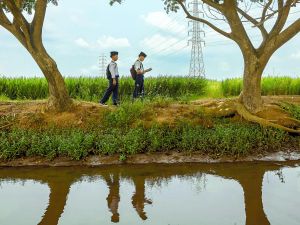
  • IB Diploma students, Creativity, Activity, and Service (CAS) can sometimes feel like one more requirement in an already demanding programme. But what if one of the simplest daily habits, walking to and from school, could meaningfully fulfill all three strands of CAS?

    Walking 30–45 minutes each day provides consistent, low-impact cardiovascular exercise. That alone should be reason enough, but we can sweeten the deal even more. Unlike intense gym sessions, walking is sustainable and accessible. Over time, it improves heart health, supports healthy weight management, and increases overall stamina. For students who spend long hours sitting in class or studying, this daily movement is especially important.

    Beyond physical benefits, walking offers something equally valuable: quiet time. A phone-free walk creates space to think, decompress, and mentally reset before and after school. The DP Psychology students will tell you that research consistently shows that moderate aerobic activity reduces stress and anxiety, improves mood, and enhances concentration. For IB students managing deadlines, Internal Assessments, and exams, this mental clarity can make a real difference.

    The ‘Activity’ strand of CAS is clearly addressed through daily walking, but the experience can go further. Students could systematically record data such as walking time, step count, body weight, resting heart rate, post-walk heart rate, and even blood pressure. Over several months, this dataset could form the basis of a Mathematics Internal Assessment, exploring correlations, regression models, or statistical trends related to fitness improvement and grades.

    Creativity might come in the form of designing a poster campaign promoting active commuting. Students could create infographics showing health benefits or data from their own tracking project. This not only fulfills the ‘Creativity’ component but also strengthens communication and design skills.

    Finally, Service could involve encouraging other students, or even teachers, to join a ‘Walk to School’ initiative. Organising a weekly group walk, tracking collective distance, or raising awareness about physical and mental health connects personal growth with community impact.

    Walking to school may seem ordinary, but within the IB framework, it becomes a powerful, multidimensional CAS experience, benefiting the body, strengthening the mind, and contributing to the school community.


  • Many European countries’ fertility rates have fallen to a level where births are not replacing deaths; populations are decreasing. The economic implications are simple to see, likely to be catastrophic, and the catastrophe is years, not decades, away.

    In Economics, Geography, Maths, and Theory of Knowledge, we should stop treating population decline as a mildly interesting demographic topic and start seeing it for what it is: an imminent and catastrophic collapse. This isn’t about empty classrooms or smaller tax bases or under-pressure pension schemes or less impact on the natural environment; it’s about insolvency of European banks and governments.

    Young Europeans are delaying or forgoing parenthood due to the perceived cost of living crisis, lifestyle changes, or existential anxieties regarding war and climate change. The reason doesn’t matter; the numbers do.

    Demographers tell us that a fertility rate of around 2.1 is required for a stable population. That’s 2.1 children per woman. But Italy’s fertility rate is about 1.25. Spain’s fertility rate is about 1.19, one of the lowest in the world. Germany’s rate is about 1.5. Poland and Greece are both near 1.3, which means their youth population will halve every generation.

    One child per couple is not enough

    Once the standard-bearers for high fertility in Europe, the Nordic countries are also in decline, with Finland reaching an historic low of 1.25. Norway: 1.40. Sweden: 1.43 and Denmark: 1.47. Lithuania: 1.21. Estonia: 1.31. Latvia: 1.36. Romania: 1.65 and Hungary, which made headlines for its aggressive pro-family policy measures, is still at just 1.51

    Finland’s situation is particularly striking because it suggests that even with world-class social safety nets, parental leave and pro-family policies, the demographic trend continues downward.

    In the Baltics, Eastern Europe and the Balkans, the crisis is compounded by a ‘grabbing of human capital. Western European employers, desperate for skilled labour and consumers, are vacuuming up graduates and skilled workers from Montenegro, Albania, and Croatia. When a doctor trained in Podgorica moves to the German healthcare system for better pay, they aren’t just taking their skills, they’re taking their future children. Countries like Bulgaria are projected to lose nearly a quarter of their population by 2050. Governments are in a quiet panic; Croatia is currently offering five-year tax breaks to lure its diaspora back.

    While some environmentalists might see a smaller population as a win for food production or carbon footprints, the Economic implications are terrifying because as populations shrink, demand for housing evaporates. Property values then fall and in a world built on mortgage-backed debt, this is lethal. If banks foreclose on homes that are worth less than the mortgage, they cannot recover their capital.

    If 2008 taught us anything, it’s that when banks face insolvency, governments must bail them out. But unlike 2008, this is not a one-off shock. It’s a trend. As debt-to-GDP ratios explode to keep the ‘too big to fail’ banks afloat, we face an existential threat to European governance.

    Too big to fail?

    What do you think? Are European banks about to fail? What about the rest of the world? Any thoughts? Feel free to leave a comment below (and feel free to forward this page to others).


  • If there’s one book every IB Diploma student should read, regardless of their subject choices, it’s William Golding’s Lord of the Flies. More than just a adventurous and dark story of stranded schoolboys, this masterpiece is a study of the human experience, a thicket of ideas that dips into almost every DP subject. It’s not just a rippingly good story; it’s an intellectual Swiss Army knife, preparing minds for the interdisciplinary rigour of the Diploma Programme.

    For the aspiring geographer, the very setting of the novel is a masterclass in physical and human geography. The isolated, tropical island isn’t just a backdrop; it’s an active character. Its resources (or lack thereof), topography, and climate dictate survival, movement, and conflict. Could the same story, the same behaviour and conflict have developed on a different island? Students can explore concepts like resource scarcity, the impact of environment on social structures, and the psychological effects of isolation; all within Golding’s vivid descriptions.

    Economics and Business Management students will find a primitive laboratory of human enterprise. The boys grapple with scarcity (food, shelter, tools), and so they discover opportunity cost. The struggle to establish a functional society provides rich discussions of Maslow’s Hierarchy of Needs: the initial focus on physiological needs (food, water, shelter) quickly gives way to safety, and then the desperate, often violent, attempts to achieve belonging and esteem. Ralph’s attempts at democratic leadership and Jack’s authoritarian rise are interesting case studies for organizational structures and power dynamics.

    Naturally, for Literature students, Lord of the Flies is a gem. Golding’s use of symbolism (the conch, Piggy’s glasses, the fire, the ‘beast’), motifs (the loss of innocence, savagery vs. civilisation), and metaphor offers endless avenues for critical analysis. The allegorical nature of the novel, exploring fundamental human nature, ensures its enduring relevance.

    Historians can contextualise the novel within the anxieties of its time because it was written in the shadow of World War II and the emerging Cold War, Golding’s exploration of human savagery resonates deeply with the atrocities witnessed in the mid-20th century. It encourages discussions on the fragility of civilisation, the origins of conflict, and the psychological underpinnings of collective violence; all themes important to understanding 20th-century history.

    Perhaps most profoundly, Lord of the Flies is a psychological thriller. It illustrates concepts central to Psychology, particularly Social Identity Theory. The rapid formation of in-groups (Ralph’s civilised faction) and out-groups (Jack’s hunters), the demonisation of the ‘other’ (Piggy, Simon, the beast), and the descent into deindividuation and mob mentality are powerfully depicted. It’s a clear demonstration of how situational factors can override individual morality.

    And for the heart of the IB Diploma, Theory of Knowledge (TOK), the novel forces students to confront profound questions of ethics: What is good? Where do moral codes come from? Are humans inherently evil or corrupted by society? The boys’ struggle for survival, their creation of rules, and their eventual abandonment of them provide a living, breathing case study for ethical dilemmas, the nature of knowledge, and the limits of reason.

    Language B students can dissect the boys’ evolving communication patterns or identify cultural references and idioms. An Extended Essay student could explore the novel’s philosophical implications, its historical context, a psychological analysis of its characters, or even a comparative study with other dystopian literature.

    But perhaps the most compelling argument for making Lord of the Flies mandatory reading for every DP student is because of its connections to the Learner Profile. Every one of the attributes: Inquirer, Knowledgeable, Thinker, Communicator, Principled, Open-minded, Caring, Risk-taker, Balanced, Reflective, can be directly applied to the characters and their actions or inactions. A simple yet powerful classroom activity emerges: how might the tragic outcome on the island have been different if all the boys had been stronger examples of these Learner Profile attributes? If more of them had been principled, caring, and open-minded, rather than succumbing to fear and savagery, could they have forged a sustainable society?

    Lord of the Flies is a compelling, thought-provoking narrative that inherently fosters critical thinking, encourages interdisciplinary connections, and prepares students for the complex, interconnected challenges of the real world. These are the qualities the IB Diploma aims to cultivate. It’s an unignorable island, demanding exploration from many academic angles.


  • After watching a documentary on the 2004 disaster, a tourist cancels their trip to Phuket out of fear of a tsunami despite the statistical rarity of a tsunami. Their brain is hijacked by the availability bias, mistaking the vividness of the documentary for a high probability of another tsunami.

    Ironically, they choose to spend their holiday driving across the United States instead. The risk of dying in a motor vehicle accident in the US is much greater than being killed in a localised natural disaster. This demonstrates how intuition prioritises memorable drama over mundane but more lethal statistics.

    Imagine a shopper walking into a luxury clothing store and seeing a designer jacket marked at $2,000. They would never pay that much, but this initial number becomes a mental ‘anchor’ that skews their perception of value for everything else they see in the store.

    When the customer finds a high-quality leather coat for $800, it seems like a bargain by comparison, even if they had planned to spend only $400. This happens because the person uses the first piece of information (that $2,000 anchor) as a reference point to judge all subsequent prices against. Despite the $800 coat being expensive, the anchoring bias makes the customer feel they are ‘saving’ $1,200 rather than ‘spending’ $800.

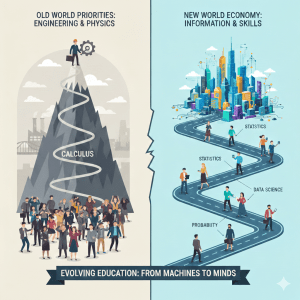
    Mathematics courses all over the world share a common trajectory: counting leads to arithmetic, which leads to algebra, which leads to geometry and trigonometry, which leads to calculus – the pinnacle of high school mathematical achievement. But this path serves an elite minority, and it fails the majority. A fundamental restructuring toward statistics and probability would equip the masses for real-world decision-making.

    Most adults never use calculus; derivatives and integrals are abstract concepts that have no use in most people’s lives. Statistical reasoning, though, pervades modern living. We encounter risk assessment in health decisions, interpret polling data in elections, evaluate claims in advertising, and navigate financial choices involving uncertainty in the supermarket, the car dealership and the real estate agent’s office. Despite this, most people lack the statistical literacy to engage accurately with these situations.

    Daniel Kahneman and Amos Tversky’s research in the 1970s showed the depth of most people’s poor decision-making. Their studies of cognitive biases showed that people systematically err when reasoning. The availability heuristic leads us to overestimate risks based on memorable events such as heavily reported shark attacks or plane crashes rather than actual frequencies of these events. The anchoring bias leads us to rely too heavily on the first piece of information we encounter, such as advertised house price, which skews our perception of all subsequent information, such as our own perceived value of a house. The framing effect reveals that our decisions can be completely reversed depending on whether options are presented as potential gains or losses; for example, people are much more likely to choose a medical treatment described as having a 90% success rate than one described as having a 10% mortality rate, even though the probabilities are identical.

    Current maths courses include very simple statistics: mean, median, mode, and perhaps basic probability. Students rarely encounter sampling distributions, hypothesis testing, confidence intervals, or Bayesian reasoning which are the very the tools needed to avoid biases. Calculus requires a lot of preparatory groundwork, but even intermediate-level statistics builds naturally from basic numeracy.

    Statistical literacy enables critical evaluation of medical studies rather than blind acceptance of health claims. Understanding even simple statistics allows voters to interpret economic information and political polls. It helps consumers understand financial products, from insurance policies to mortgages to investments. In a world saturated with misleading, statistical skills are an essential civic competence.

    Critics might argue that calculus develops abstract reasoning skills valuable beyond its direct applications, but statistical thinking offers equally rigorous intellectual development while maintaining a deeply practical relevance. Grappling with uncertainty, understanding variability, and distinguishing correlation from causation demand sophisticated analytical thinking. And statistics connects naturally to other disciplines such as psychology, economics, biology, geography…, making mathematics feel applicable and relevant rather than isolated and irrelevant.

    The traditional calculus pathway reflects old world priorities when engineering and physics dominated higher education. Today’s knowledge and information economy demands different skills.

    A reformed curriculum might teach numeracy and descriptive statistics early, progress to probability theory and inferential statistics in middle years. Calculus can remain as an optional specialization for those pursuing specific technical fields. This inversion would serve the many rather than the few, equipping citizens with tools to navigate uncertainty, evaluate evidence, and make reasoned decisions in a complex world. Kahneman and Tversky showed us how and why we fail. Statistics and probability can change that.


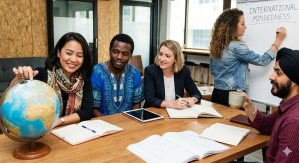
  • International mindedness is inherently a mindset of openness to the world, a recognition of our shared humanity, and a genuine respect for cultural diversity. By developing the ability to see the world through multiple lenses, we help students move past ethnocentrism and selfishness towards a real state of empathy, a capability that’s as much about intellectual rigour as it is about social responsibility.

    One way to teach International Mindedness in DP Psychology and Theory of Knowledge is to challenge a basic assumption: that what we call ‘normal’ is a universal constant because, ‘normal’ is deeply entangled in culture.

    For students of the human sciences, exploring culture-specific mental health experiences dismantles the idea that Western diagnostic categories (like those in the DSM-5) are objective, universal truths. In 1951, Malaysian psychiatrist Pow Meng Yap questioned whether Western frameworks could meaningfully explain local experiences. This question invites us to practise international mindedness by acknowledging that our cultural frameworks are just one of many, rather than ‘the default setting’ for all humanity.

    We can look at three specific examples where behaviour is shaped by culture:

    • Latah (Malaysia / Southeast Asia): This is a response to sudden fright, most often seen in middle-aged women. Latah involves heightened suggestibility and imitation of others’ behaviour. It isn’t an ‘error’ in physiology. It is a behaviour that only has meaning within local social norms regarding gender, obedience, and social harmony.
    • Koro (East and Southeast Asia): A syndrome where individuals (most often young men) experience an overwhelming fear that their genitals are retracting into the body resulting in death. The distress is physiological and real, but the form of the crisis is steeped in cultural beliefs about anatomy and death.
    • Spiritual guidance and pathological hallucinations (Ghana / India): In the West, hearing voices indicates schizophrenia, but in Ghana, voices are interpreted as spirits or God giing moral guidance. In India, voices are often perceived as playful, often from familiar family members. In all cases, the perceptual event is the same, but the knowledge system applied to it changes the interpretation from a terrifying mental illness to comforting guidance.

    Students can be forgiven for thinking that diagnostic labels, such as schizophrenia or ADHD, have been ‘discovered’ like elements on the Periodic Table, but international mindedness encourages them to see labels/diagnoses as cultural constructs. By studying Latah or Koro, students can learn to separate the universal concept of human suffering from the culture-based narratives used to explain that suffering. This fosters a more nuanced understanding of the sociocultural approach to understanding and explaining behaviour.

    The implications for Theory of Knowledge are similarly profound. These culture-specific disorders urge students to ask:

    • Who gets to decide which experiences count as illness versus spirituality? (Scope)
    • If mental health categories and labels are constructed, what does this reveal about the reliability of the human sciences? (Perspectives)
    • Is it ethical to impose ‘Western’ psychological ‘knowledge’ on cultures that have their own functioning systems of meaning? (Ethics)

    International mindedness asks students and teachers to tolerate discomfort; the realisation that ‘Western’ frameworks are not necessarily wrong, but they are perhaps incomplete.

    When we diagnose distress without looking at social contexts, we risk turning suffering or ill-ease into an individual brain problem. For IB students, developing international mindedness means asking questions like ‘Whose knowledge?’, ‘In what context?’, and ‘For whose benefit?’ When we teach students to see that mental health does not exist without a context, we aren’t just teaching them Psychology or Theory of knowledge, we are helping them develop the humility and global perspective necessary to be internationally minded citizens.


  • Do you remember when teachers were agitated and dismayed and moaning into our Nescafe in the staffroom about Wikipedia? ‘Unreliable,’ we lamented.

    Wikipedia’s now become a relatively trusted and frequently visited website. It’s often the first stop for students (university and high school) researching  assignments, adults checking a fact, and even journalists refreshing their memories. Unlike peer-reviewed journals, the ‘pedia is written and edited by amateurs (mostly), volunteers, ordinary people who are not credentialed, PhD-ed experts. So how did we come to trust it so much? Did the ‘pedia get better, or is it an illusion – other web-based sources are even worse?

    The ‘pedia’s story is, in many ways, a mirror of our digital age. When it was launched in 2001, the idea that “anyone can edit” seemed reckless, even dangerous. But over time, its collaborative model produced something remarkable: a living, constantly updated repository of human knowledge. Its openness invited thousands and then millions of contributors to fact-check, debate, and refine information in real time. That communal process is inherently imperfect but it also corrects errors faster than traditional publications can. In a world that moves at internet speed, authority has become less about formal credentials and more about transparency and responsiveness.

    Our dependence on the ‘pedia also reveals something unsettling about us – convenience and no-cost seems more important to us than credibility. A neatly summarised article, complete with citations and a clean interface, feels authoritative, even when we don’t verify its sources. This trust speaks not only to the ‘pedia’s success but also to a broader problem: our declining skill of critical thinking. We skim, we accept, and we move on, rarely questioning who wrote an article, what their motives were, or whether alternative perspectives might exist.

    The ‘pedia’s popularity is a triumph of collective intelligence, but it’s also a test of our discernment. It shows that humans are capable of remarkable cooperation, yet still vulnerable to the illusion of knowledge. Perhaps the lesson is not to distrust tje ‘pedia, but to understand it for what it is: a starting point, not an endpoint. In the age of open information, our greatest responsibility isn’t to reject accessible knowledge, it’s to engage with it – critically.

    The ‘pedia tells two stories at once: one of human ingenuity, and one of human gullibility. Which story defines us depends on how carefully we read and whether our teachers taught us how to think critically.


  • To everyone involved in creating and maintaining IBExchange: thank you! Truly.

    For those of us who’ve been teaching the IB long enough to remember the OCC (Online Curriculum Centre), yes, I know, I’m showing my age, IBExchange feels like a breath of fresh air. The OCC served its purpose in its day, but IBExchange is something altogether different: modern, well-organised, collaborative, official, and teacher-friendly in every way.

    What strikes me most is how thoughtfully it has been designed. There’s a dedicated section for every subject, and within each, a community chat space led by a subject expert, often a workshop leader or curriculum insider. This is the perfect space to ask for official advice or to get authoritative answers about Subject Guides, assessment expectations, and exam procedures. No more posting questions in unofficial social media groups and sorting through a pile of conflicting or speculative replies. IBExchange provides clarity, professionalism, and accuracy, all in one place.

    Then there’s the treasure trove of teacher resources. Some are professional development materials such as pptx presentations, videos, and documents that help us grow as educators. Others are classroom-ready teaching materials created by subject experts and peer-reviewed by other experts. Everything comes with the IB’s seal of approval, which means we can finally stop worrying about quality or compliance. And did I mention? It’s all free. That alone makes IBExchange infinitely more valuable than many of the overpriced, inconsistent subscription sites that have popped up over the years.

    It’s hard not to feel a little giddy about it, honestly. This is exactly the kind of platform IB teachers have needed for years: a space that combines community, credibility, and collaboration. My only surprise is that more teachers aren’t using it yet. If you haven’t already, you can access it easily through your MyIB page and once you’re there, you’ll wonder how you managed without it.

    So, to the IB team, the subject managers, the workshop leaders, the reviewers, the developers, and everyone else behind the scenes: thank you. You’ve created something extraordinary for educators around the world. IBExchange isn’t just an upgrade from the old OCC; it’s a giant leap forward for the entire IB teaching community.

    With genuine appreciation,
    A grateful IB teacher